


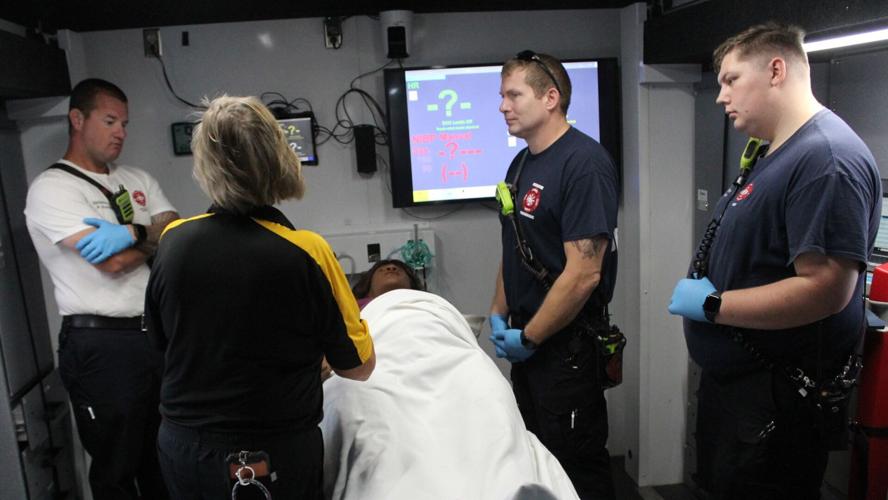
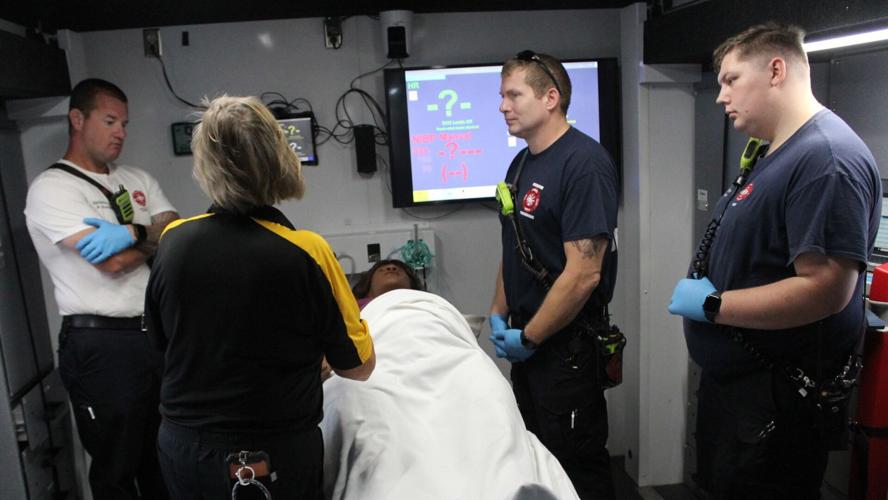
MUSCATINE, Iowa – Over the past three days, Muscatine Fire Department personnel participated in hands-on emergency medical training through Simulation in Motion–Iowa (SIM-IA), a statewide program operated by University of Iowa Hospitals & Clinics that brings high-fidelity clinical simulation directly to EMS providers.
“This is the second time Muscatine Fire has used this training opportunity,” said Battalion Chief Andrew McSorley, who also serves as the department’s EMS operations chief. “It’s extremely solid training for both our veteran staff and our newest team members.”
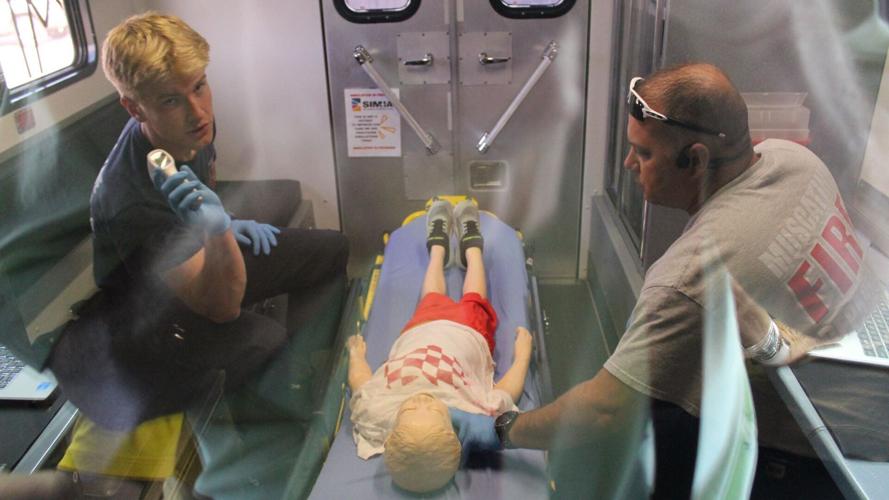
The SIM-IA mobile unit includes two fully equipped simulation rooms—one modeled after an ambulance and the other after an emergency department bay. Between them sits a control room where instructors operate advanced manikins capable of mimicking real patients. These manikins can talk, blink, breathe, bleed, sweat, vomit, and display pulses, giving EMS personnel a realistic environment to practice critical skills.
People are also reading…
During Muscatine’s training sessions, one scenario involved a woman in active labor, while another focused on a dehydrated juvenile patient. Firefighters worked in teams of two, assessing and treating each simulated patient while instructors interacted as the “voice” of the victim.
“We ran the entire department through scenarios that focus on skills you may not get to use very often,” McSorley said. “It’s a chance to practice high-risk, low-frequency situations in a controlled environment.”
After each scenario, instructors conducted a detailed debrief, reviewing what went well, what could be improved, and what lessons could be applied to real-world patient care.
McSorley emphasized that SIM-IA’s mobile training is provided at no cost to EMS agencies that request it.
Muscatine Fire first utilized SIM-IA’s mobile training program in December 2020. During that visit, crews worked through two high-intensity scenarios: one involving an individual who had fallen 18 feet from a tree stand and suffered a severe impalement injury to the leg, and another focused on a critically ill juvenile patient in need of urgent care.
According to SIM-IA, the program provides high, mid, and low-fidelity simulation experiences to healthcare providers across Iowa. While simulation is common in formal medical education, many certified EMS providers—especially in rural areas—lack access to advanced training resources after entering the field.
SIM-IA’s mobile approach allows EMS teams to train in their own community without disrupting staffing or patient care, while reducing travel and education costs.
Simulation training helps EMS personnel:
- Practice rare clinical situations that may not occur frequently
- Learn new procedures and equipment through hands-on experience
- Strengthen teamwork and communication during high-pressure incidents
- Identify operational challenges before they impact patient care
- Maintain high-quality, evidence-based practice across the state
To learn more about SIM-IA, visit Simulation in Motion–Iowa.


